

Compounder Fund: Starbucks Sell Thesis - 13 Jul 2026
Data as of 12 July 2026
We first invested in Starbucks (NASDAQ: SBUX) for Compounder Fund’s portfolio in July 2020. Our investment thesis for the company can be found here. In late-March 2026, we completely exited Starbucks. This article describes our Sell thesis for the company.
One of the key traits that attracted us to coffee chain giant Starbucks initially was its history of doubling its global store base from 15,100 to 31,256 from FY2007 (fiscal year ended September 2007) to FY2019, while producing positive comparable store sales growth in all years in that period with the exception of FY2008 and FY2009, which were during the Great Financial Crisis. The foundation for this track record was, in our opinion, two things that made Starbucks special: The creation of a sense of community in its stores; and the dignified way it supports its partners (till today, Starbucks calls its employees partners). In turn, Starbucks’ strong showing in comparable store sales laid the groundwork for it to produce impressive compound annualised growth rates of 9.0%, 15.0%, and 23.8% for its revenue, net income, and free cash flow, respectively, from FY2007 to FY2019. On a per share basis, the growth rates were even better, as Starbucks’ weighted average diluted share count had declined by 1.8% per year over the same period.
But after our investment, the company’s performance gradually started to weaken under new leadership. When we first invested, Kevin Johnson was the CEO. He stepped into the role in April 2017, succeeding Starbucks’ legendary leader, Howard Schultz. In April 2022, Johnson stepped down as CEO. Laxman Narasimhan joined the company as would-be CEO in October 2022 before officially taking over the baton in April 2023. Unfortunately, Narasimhan had a difficult time leading the company. Starbucks’ quarterly comparable store sales growth declined under his watch and even turned negative; this was an important factor in our decision to trim Compounder Fund’s position in the company in August 2024.
Around a week after the trim, Starbucks surprisingly hired Brian Niccol to replace Narasimhan. Niccol was the CEO of another Compounder Fund holding, Chipotle Mexican Grill. We were impressed with Niccol’s accomplishments at Chipotle, as we thought he had managed to retain what was special about Chipotle while improving the areas that needed fixing. So we were optimistic that Starbucks was in good hands, even though we were not thrilled that Chipotle had lost an excellent leader.
Niccol ran his Chipotle-playbook at Starbucks. He identified the traits that made the company unique, while attempting to mend the problematic areas. Here are some of the relevant commentary from Niccol and his team in recent earnings conference calls (emphases are ours):
“[From Starbucks’ FY2024 fourth-quarter earnings conference call] Our financial results were very disappointing, and it is clear we need to fundamentally change our strategy to win back customers and return to growth. Back to Starbucks is that fundamental change. We have to get back to what has always set Starbucks apart, a welcoming coffee house where people gather and where we serve the finest coffee, handcrafted by our skilled baristas. Regardless of the consumer environment, we must be at our best to succeed. And right now, despite the hard work of our Green Apron Partners we aren’t always at our best. I’ve heard that while people love Starbucks, some feel like we have drifted from our core. We’ve made it harder to be a customer than it should be, and we focused our marketing too narrowly on Starbucks Rewards members. I’ve spent my career understanding, building and stewarding brands, and it’s clear the Starbucks brand is iconic and loved. My experience tells me that when we get back to our core identity and consistently deliver a great experience, our customers will come back.”
“[From Starbucks’ FY2025 first-quarter earnings conference call] Our path Back to Starbucks in the US is driven by four core initiatives: reintroduce Starbucks to the world, deliver the customer experience to win the morning, reestablish Starbucks as the community coffeehouse, and ensure Starbucks is the unrivaled best job in retail…
…Through the quarter, we’ve continued to test and learn as we position the business to achieve our 4-minute throughput goal with a moment of connection. It’s become clear through our pilot work that order sequencing creates more of a bottleneck than capacity. In short, investments in staffing and deployment, processes and algorithm technology demonstrate the greatest opportunity to deliver a 4-minute wait time in most of our cafes. As a result, we’ve started to segment stores by transaction volume and are now targeting installation of Siren equipment only in our highest quartile stores where it is needed to meet our throughput expectations. We’ve also invested additional coverage hours across more than 3,000 U.S. company-operated stores through precision scheduling, introduced new brewed coffee and tea routines, and simplified beverage builds. And soon, we’ll launch a pilot across 700 stores, looking at staffing levels to improve our green apron partners’ ability to serve the world’s finest coffee with a moment of connection.”
“[From Starbucks’ FY2025 second-quarter earnings conference call] We’re relentlessly focused on the customer, and we’re continuing to invest in a green apron service model that enables throughput and connection with our customers. We’re also reestablishing our coffee houses as a third place where customers spend time and build community…
…We’ve moved quickly over the past several months to make small but impactful improvements to the coffee house experience. We’re creating moments of connection with handwritten notes on cups, and we’re making it more enticing to stay in our cafes with ceramic mugs, an expanded free refill policy and the return of great seats. As a result, we’ve seen more customers choose to sit and stay in our cafes, and we continue to receive overwhelmingly positive feedback from customers, demonstrating that small details and hospitality drive satisfaction. The third place is our heritage. It’s needed more than ever, and we’re reclaiming it. That’s why we’re evolving our coffee house design standards to provide customers a welcoming space to connect and build community. We’ll begin to bring reworked coffee houses online soon, and we think they will truly deliver an exceptional experience. The uplifts feel premium but keep renovation costs down and minimize closure days. They’re warm and invite customers in. They create a sense of craft and they have great seats for different occasions. Expect to see these uplifts begin to open in New York City and Southern California in the months ahead…
…Partner engagement is up, turnover has dropped to under 50%, which is a new recorded low…
…During the quarter, we launched an update to Shift Marketplace that lets partners pick up and trade shifts within their district. It’s increased the pool of partners to fill last-minute shift changes by 10x and has resulted in record high shift completion with 0.5 million more shifts filled year-over-year.”
“[From Starbucks’ FY2025 fourth-quarter earnings conference call] We made much needed investments in staffing and hours to put more partners on the floor at the right times. We reassessed and extended hours of operations for about half of our U.S. company-operated portfolio so that nearly all are now open consistently at or before 5 a.m. We expanded rosters and maintained healthy hours per partner. And as a result, we had strong partner engagement, record low hourly partner turnover and improved customer experience scores in the fourth quarter…
…We launched our Smart Queue sequencing algorithm. Since implementation, more than 80% of our U.S. company-operated coffeehouses had cafe service times averaging 4 minutes or less, even with greater transaction volumes following our fall launch…
…We’re taking a disciplined approach to how, where and what we build to improve both the customer experience and unit economics. We are piloting a new coffeehouse prototype with lower build costs and optimized space utilization that still deliver a full coffeehouse experience aligned to our brand.”
“[From Starbucks’ FY2026 first-quarter earnings conference call] Over the past several months, we have surfaced legacy models and processes in our business that we are now fixing. For example, transaction growth has shown us continued opportunities to strengthen our supply chain and reevaluate menu offerings to ensure product availability while reducing future waste…
…We’re also continuing to refine our labor model because we see some opportunities to fine-tune it based on store format and performance. There’s also opportunity to better enable efficiencies with technology solutions in our coffeehouses and across our support centers around the world…
…Brand affinity in the U.S. remained strong during the quarter, with continued improvements in visit consideration and Starbucks ranking as a customers’ first choice. Connection scores improved with more customers saying our partners make an effort to get to know them. Convenience scores improved significantly as customers responded to our Green Apron Service standard and improved in-stock levels. And more customers said Starbucks offers great tasting food and healthy menu choices.”
The effect of Niccol and his team can be seen in the gradual improvement in Starbucks’ quarterly comparable store sales growth shown in Table 1 below (compare the numbers after FY2024’s fourth quarter with those before; Narasimhan was replaced by Niccol mid-way through the quarter).
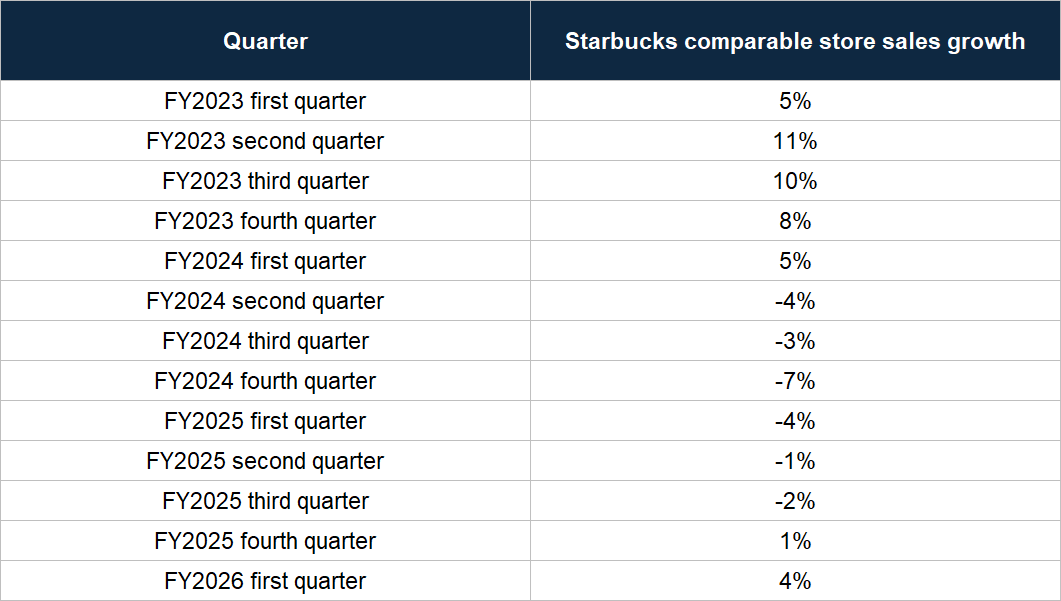
Table 1; Source: Starbucks quarterly earnings updates
But the near-term future of Starbucks still looked anaemic when we sold. In Starbucks’ FY2026 first-quarter earnings update, management guided for total revenue and comparable store sales growth of just around 3% each for the fiscal year. If it comes to pass, Starbucks will be one of, if not the, slowest-growing company in Compounder Fund’s portfolio*. At the time of our Starbucks sale, we wanted to raise capital for adding to Compounder Fund’s existing position in Meta Platforms. Given Starbucks’ growth profile, we thought it would be a suitable Sell candidate, since we saw Meta Platforms’ future return as being more certain and materially higher. We made our initial investment in Starbucks at an average price of US$77 per share and sold at an average price of US$87.
*Updated guidance for FY2026 from Starbucks’ management given in the FY2026 second-quarter earnings update called for total comparable store sales growth of 5%, but flat total revenue growth.
And here’s an important disclaimer: None of the information or analysis presented is intended to form the basis for any offer or recommendation; they are merely our thoughts that we want to share. Of all other companies mentioned in this article, Compounder Fund owns shares in Meta Platforms. Holdings are subject to change at any time.
