

Compounder Fund: Shinhan Financial Group SELL Thesis - 13 Jul 2026
Data as of 12 July 2026
We first invested in Shinhan Financial Group (KSE: 055550)(NYSE: SHG) for Compounder Fund’s portfolio in late-June 2025. Our investment thesis for the company can be found here. In late-May 2026, we completely exited Shinhan Financial Group. This article describes our Sell thesis for the company.
We invested in Shinhan Financial Group (abbreviated as SFG from here on) as a special situation. The South Korean government introduced the Corporate Value-Up Program in February 2024 and SFG was among the first companies in the country to heed the call. Our thesis for SFG rested on the company achieving the following 2027 targets set by management in response to the Corporate Value-Up Program:
- Increase its return on equity to 10%
- Increase its shareholder return – which refers to share repurchases and dividends as a percentage of net income – to 50%
- Reduce its share count to 450 million through buybacks
- Grow its tangible book value per share (TBPS) to ₩130,000
Our view is that if SFG can do what its management laid out, when its TBPS is at the 2027 target of ₩130,000, its price-to-book (P/B) ratio would likely have risen from 0.6 when we first invested to around 1. This provides Compounder Fund with an upside of more than 100%. We also think it’s possible that SFG’s P/B ratio could rise to around 1 way before the end of 2027, in which case Compounder Fund would also earn a handsome return.
It turns out that the latter case had played out. SFG’s P/B ratio was 0.9 when we sold it. Our average sale price was US$64, 43% higher than our initial average buy price of US$45. SFG had made good progress in meeting its 2027 targets when it was in Compounder Fund’s portfolio, as shown in Table 1 below. We think this has been an important driver for the rise in its stock price. The fund’s return in SFG could have been higher if not for a 10% decline in the Korean won against the US dollar during the holding period; for perspective, SFG’s Korea-listed shares saw their price rise 54% over the same time frame.
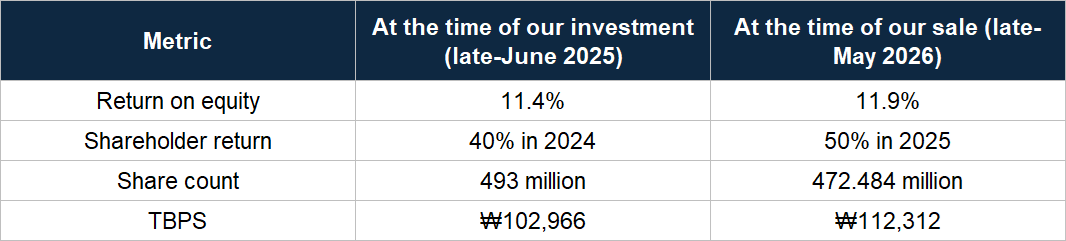
Table 1; Source: SFG’s earnings updates
At the time of our sale of SFG, we thought that its forward return-potential was lower than new special-situation opportunities we found (in this case, Mercer Bancorp and Ponce Financial Group) and so we wanted to free up capital. If we assume that SFG meets its 2027 targets, its US-listed shares would have a price of US$86 with a P/B ratio of 1 based on the won-to-dollar exchange rate at the time of our sale. This equates to an overall return of just 34% (and an annualised return of around 20%) from our average sale price. As our investment theses on Mercer Bancorp and Ponce Financial Group shows, we see higher forward returns from them (both in terms of absolute and annualised returns) compared to SFG.
There was another push-factor for our decision to sell SFG: Signs of over-exuberance in the South Korean stock market. Here are the salient things we saw:
- The benchmark for South Korea’s stock market, the KOSPI Composite Index, was up by 78% from the start of this year to just the middle of May, driven by gains of 180% and 126%, respectively, from the memory chip manufacturers SK Hynix and Samsung; the two companies accounted for more than 40% of the KOSPI in mid-May 2026.
- In the weeks before our sale of SFG, South Korea was preparing for the launch of leveraged exchange-traded funds linked to either SK Hynx or Samsung Electronics.
- South Korean investors were participating in the stock market in risky ways; Bloomberg reported on 14 May 2026 that “margin balances hit a record 36.3 trillion won earlier in May, up 32% from the end of December,” and this may even be understating the extent of the leverage involved.
SFG is the first special-situation investment we made for Compounder Fund and we think it has been a success, with a gain of 42.7% from our initial average buy price in less than a year. As mentioned earlier, the capital from the sale of SFG was redeployed to two other special situations – Mercer Bancorp and Ponce Financial Group – that we think could produce higher forward returns than SFG.
And here’s an important disclaimer: None of the information or analysis presented is intended to form the basis for any offer or recommendation; they are merely our thoughts that we want to share. Of all other companies mentioned in this article, Compounder Fund owns shares in Mercer Bancorp and Ponce Financial Group. Holdings are subject to change at any time.
