

Compounder Fund: Ponce Financial Group Investment Thesis - 13 Jul 2026
Data as of 12 July 2026
Ponce Financial Group (NASDAQ: PDLB) is a company in Compounder Fund’s portfolio that we invested in for the first time in late-May 2026. This article describes our investment thesis for it.
Company description and background
We invested in Ponce Financial Group (abbreviated as PFG from here on) because we believe it’s currently undergoing a special situation and has hidden asset value. In Compounder Fund’s website and Owner’s Manual, we described such situations as stocks “where step-changes in regulations or market conditions are likely to benefit their businesses in the future” and “that hold assets with economic value that are currently not recognised by the market.” Consequently, this investment thesis will not have the same structure as our other theses.
PFG is the holding company for Ponce Bank, whose roots can be traced to 1960, when the Ponce De Leon Federal Savings and Loan Association was established. Ponce Bank, as its name suggests, is a bank. Its headquarters is in the state of New York in the USA. All but one of its 13 full service banking offices are located in the same state.
Ponce Bank’s primary business is in issuing various types of mortgage loans, such as for one-to-four family residential properties (both investor-owned and owner-occupied), multifamily residential properties, nonresidential properties, construction, and land. To a smaller extent, it also issues business and consumer loans. Figure 1 below shows the composition of Ponce Bank’s loans portfolio as of 31 March 2026. Residential-related loans collectively accounted for 49.4% of Ponce Bank’s total gross loans, with multifamily residential mortgage loans being the single largest loan-category with a 33.6% weight.
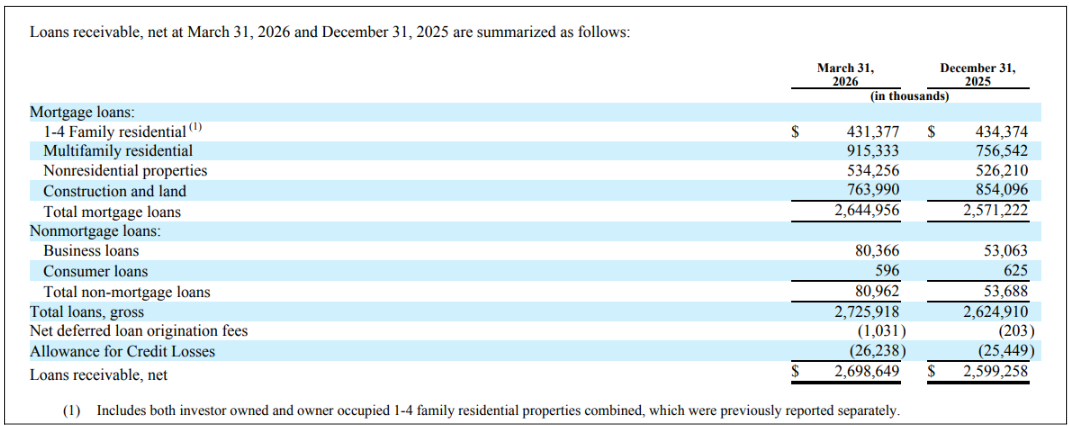
Figure 1; Source: PFG 2026 first quarter earnings filing
Most of Ponce Bank’s loans are issued to borrowers from the New York City metropolitan area, in a reflection of where the bank’s offices are located. It’s worth noting that the weighted-average loan-to-value ratio for Ponce Bank’s loans portfolio was a healthy 50.5% as of 31 March 2026, which suggests the bank has been lending conservatively.
The special situation
In our eyes, PFG is a special situation investment opportunity because it is a thrift conversion. We discussed thrift conversions in detail, including the conversion mechanics and the returns-potential, in our 2024 fourth-quarter and 2025 second-quarter letters. In these letters, we laid out the investment criteria we look out for in thrift conversions:
- “The equity-to-assets ratio: The higher the better, as it signifies an over-capitalised and strong balance sheet, and would make a thrift look attractive to a would-be acquirer
- The P/TB [price-to-tangible book] ratio: The lower the better, as a P/TB ratio that is materially below 1 will (a) make share buybacks a value-enhancing activity for a thrift’s shareholders, and (b) enhance the potential return for us as investors
- Share buybacks: The more buybacks that happen at a P/TB ratio below 1, the better, as it is not only value-enhancing, but also indicates that management has a good understanding of capital allocation
- Non-performing assets as a percentage of total assets: The lower the better, as it signifies a thrift that is conducting its banking business conservatively
- Net income: If the play is for a potential acquisition of a thrift, we want to avoid a chronically loss-making thrift as consistent losses indicate risky lending practices, but the amount of net income earned by the thrift is not important because an acquirer would be improving the thrift’s operations; if the play is for a thrift to generate strong returns for investors from its underlying business growth, then we would want to see 20 a history of growth in net income and at least a decent return on equity (say, 8% or higher)
- Change in control provisions: This relates to payouts that a thrift’s management can receive upon being acquired and such information can typically be found in a thrift’s DEF 14-A filing; if management can receive a nice payout when a thrift is acquired, management is incentivised to sanction a sale
- Management’s compensation: The annual compensation of a thrift’s management should not be high relative to the monetary value of management’s ownership stakes in the thrift”
PFG conducted the first-step of its conversion in September 2017 and its second-step on 27 January 2022. Before we lay out our thesis for PFG from the thrift-conversion angle, it’s important to detour to the hidden asset value in the company.
The hidden asset value
PFG’s hidden asset value resides in the ECIP preferred stock that the company had issued to the US Treasury.
The acronym ECIP stands for “Emergency Capital Investment Program.” It was established by the US government in March 2021 in the wake of the COVID-19 pandemic as part of a series of measures to provide economic support to the American public. The ECIP is meant for the government to inject capital directly to CDFIs (Community Development Financial Institutions) or MDIs (Minority Depository Institutions) so that they can offer financial support, in the form of loans, grants, and forbearances etc., to small businesses, minority-owned businesses, and consumers in low-income and underserved communities.
Under the ECIP, PFG issued 225,000 shares of preferred stock to the US Treasury on 7 June 2022 for US$225.0 million. This preferred stock had some really attractive characteristics for PFG when it was issued:
- No dividends will accrue for the preferred stock in the first two years of its issuance. For the third to the 10th year, the annual dividend rate will be 2.0%, 1.25%, or 0.5%, depending on the level of Qualified and/or Deep Impact Lending performed by PFG. Qualified Lending and Deep Impact Lending are, broadly speaking, loans provided to the following groups: Low-to-moderate income individuals; rural, low-income, underserved or minority communities; counties in persistent poverty; small businesses and farms; and affordable housing projects, public welfare and community development investments, and community facilities. The annual dividend rate for the 11th year onwards will be fixed at one of the three rates.
- The dividends on the preferred stock are non-cumulative, meaning PFG does not have to make up for any dividend that it chooses not to pay. There are some consequences for PFG if it fails to pay the preferred stock’s dividend, but they are relatively minor (for example, PFG will not be allowed to pay a dividend on its common stock).
- The ECIP preferred stock is perpetual, meaning PFG does not ever have to return the capital to the US Treasury.
With the passage of time, it became even clearer that the ECIP preferred stock is a valuable asset for PFG:
- As of the first quarter of 2026, PFG has reported 15 consecutive quarters in which it has met the conditions for Qualified and Deep Impact Lending. As a result, PFG’s ECIP preferred stock currently has an annual dividend rate of just 0.5%.
- On 20 December 2024, PFG and the US Treasury signed an option agreement regarding the repurchase of the ECIP preferred stock. The agreement gives PFG the option to buy all 225,000 shares of the ECIP preferred stock back from the US Treasury in the first 15 years from the preferred stock’s issuance. The price will be based on a formula to calculate the present value of the preferred stock and PFG’s management currently expects it to be just 6.79% of the preferred stock’s face value. This means PFG could potentially pay just US$15.28 million to the US Treasury to repurchase all 225,000 shares of the ECIP preferred stock. This substantial discount is in line with the US Treasury’s announcement on 13 August 2024 that as of March 2024, any repurchases of ECIP preferred stock by an issuer can be done at a price ranging from 7% to 28% of the principal amount. As another sanity check, consider the present value of a perpetual annual cash flow of US$1.125 million, which is the annual cash flow accruing to the US Treasury from PFG’s ECIP preferred stock, given the current annual dividend rate of 0.5%. At a discount rate of 7%, the present value of the US$1.125 million cash flow is US$16.07 million, which is just 7% of the face value of PFG’s ECIP preferred stock (a discount rate of 7% is used to reflect the current yield of around 5% for US 30-year Treasury bonds and the additional risk present in the cash flow, since the dividend on the preferred stock is non-cumulative).
- PFG cannot exercise the option to repurchase the ECIP preferred stock until at least one of the Threshold Conditions are met. There are three Threshold Conditions, namely (1) an average of at least 60% of PFG’s total loan originations are under the Deep Impact Lending criterion over any 16 consecutive quarters in the first 10 years from the issuance of the ECIP preferred stock, (2) an average of least 85% of PFG’s total loan originations are under the Qualified Lending criterion over any 24 consecutive quarters in the first 10 years from the issuance of the ECIP preferred stock, and (3) the ECIP preferred stock has an annual dividend rate of no more than 0.5% for any six consecutive years in the first 10 years from the issuance of the ECIP preferred stock. The earliest possible date on which PFG could meet a Threshold Condition is 30 June 2026, which means the repurchase of the ECIP preferred stock could happen as soon as the third quarter of this year, assuming PFG successfully meets a Threshold Condition.
It’s worth noting that PFG’s management has commented on multiple occasions about their intention to repurchase the ECIP preferred stock. Here are a few examples:
“[From the 2025 second-quarter earnings report] We’re mindful of our percentage of deep impact lending, as we need to be at 60% or above for 16 quarters cumulatively, as a condition to buy the preferred stock back. After 12 quarters, including the quarter ended June 30, 2025, we are at 80% deep impact lending.
[From the 2025 third-quarter earnings report] We’re mindful of our percentage of deep impact lending, as we need to be at 60% or above for 16 quarters cumulatively, as a condition to buy the preferred stock back. After 13 quarters, including the quarter ended September 30, 2025, we are at 81% deep impact lending.
[From the 2025 fourth-quarter earnings report] We’re pleased with our levels of loan growth as we continue to make progress towards our commitments under the U.S. Treasury’s Emergency Capital Investment Program. As previously reported, we expect that our dividend yield will continue at the 0.50% level in the next dividend period starting later this year and we’re close to achieving 16 quarters of a cumulative deep impact lending percentage of more than 60%. After 14 quarters, including the quarter ended December 31, 2025, we are at 82% deep impact lending.
[From the 2026 first-quarter earnings report] We continue to make progress towards our commitments under the U.S. Treasury’s Emergency Capital Investment Program and we’re one quarter away from achieving 16 quarters of a cumulative deep impact lending percentage of more than 60%. After 15 quarters, including the quarter ended March 31, 2026, we are at 82% deep impact lending.”
Management’s repeated mention of “16 quarters” is in reference to one of the Threshold Conditions discussed above that PFG has to meet before it can exercise the option to repurchase the ECIP preferred stock. If PFG ends up repurchasing the preferred stock for US$15.28 million, a price representing 6.79% of the preferred stock’s face value, US$209.72 million can be added to the company’s common stockholder’s equity. Based on PFG’s last reported share count of 24.1879 million, the repurchase of the ECIP preferred stock could add US$8.67 per share of value to PFG.
Back to the special situation
Coming back to PFG’s thrift conversion, here’s how the company stacks up against our criterion.
On the equity-to-assets ratio
As of 31 March 2026, PFG had total assets of US$3.301 billion and tangible common stockholders’ equity of US$326.363 million, giving a tangible common stockholders’ equity to assets ratio of a mediocre 10.1% on the surface. But some adjustments are necessary:
- PFG’s total assets include held-to-maturity securities at an amortized cost of US$263.514 million as of 31 March 2026; these securities have a fair value of US$258.007 million. PFG’s total assets also include loan receivables of US$2.699 billion as of 31 March 2026 with a fair value of US$2.668 billion.
- PFG’s equity includes ECIP preferred stock with a face value of US$225 million. As mentioned earlier, the ECIP preferred stock is likely to be repurchased at a substantial discount to its face value and add US$209.72 million to the company’s common stockholder’s equity.
- After adjusting PFG’s tangible common stockholders’ equity of US$326.363 million with the fair values of its held-to-maturity securities, loan receivables, and the ECIP preferred stock, the tangible common stockholders’ equity becomes US$499.579 million. This gives an adjusted common stockholders’ equity to assets ratio of a healthy 15.3%.
On the P/TB ratio
Based on reported financials, PFG’s tangible book value per share is US$13.49, which gives a P/TB ratio of 1.4 at our average purchase price of US$18.42. But using PFG’s adjusted tangible common stockholders’ equity and last reported share count, the company’s adjusted tangible book value per share becomes US$20.65 and its P/TB ratio thus falls to 0.9.
On share buybacks
Since the first-anniversary of its second-step conversion, PFG had started one repurchase programme which ran from May 2023 to August 2023 (a converted thrift is allowed to repurchase shares from the first year onwards of its conversion). Under the programme, PFG repurchased 1.235 million shares, which was 5% of the company’s then share count, at a discount to reported book value per share of around 20%.
We would ideally have preferred to see management conducting more repurchases of PFG shares, but the aforementioned repurchase programme is still a positive signal on management’s understanding of capital allocation.
On non-performing assets
PFG’s non-performing assets as a percentage of total assets since 2020 are shown in Table 1 below. The numbers are not exceptional nor bad.
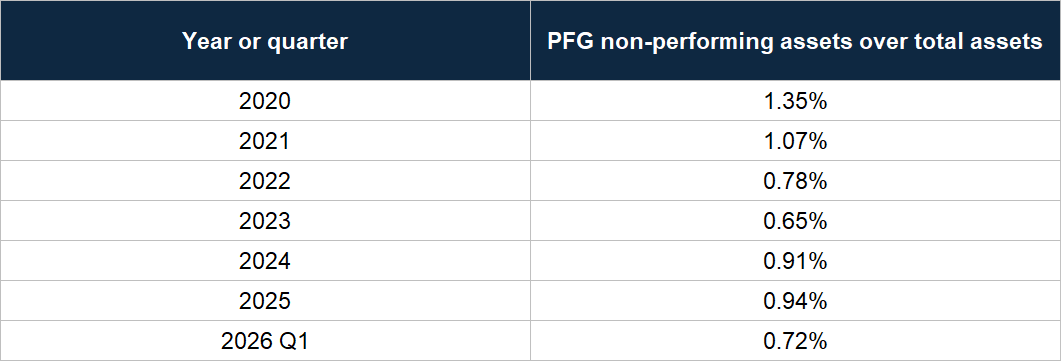
Table 1; Source: PFG annual reports and quarterly filings
On net income
PFG’s net income has largely been positive since its second-step conversion and has grown materially in recent times, as shown in Table 2 below.
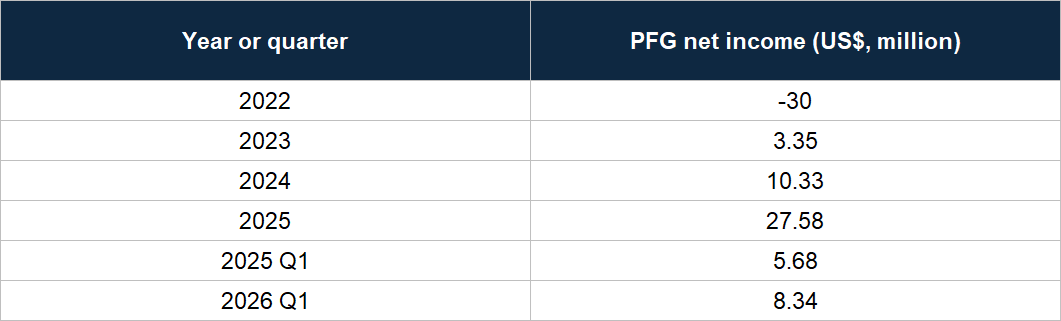
Table 2; Source: PFG annual reports and quarterly filings
On change in control provisions
The two most important leaders in PFG are:
- Executive chairman Steven Tsavaris. He has served as a director since 1990 and joined Ponce Bank in 1995 as an executive president before becoming CEO in 2011. He became chairman of the board and CEO of Ponce Bank in 2013. Tsavaris is already 76.
- President and CEO Carlos Naudon. He has served as a director since 2014 and became president and COO of Ponce Bank in 2015. Naudon is already 75.
Both Tsavaris and Naudon have compensation plans that include attractive change in control provisions. In the event that PFG or Ponce Bank is acquired and their employment is terminated, they are each entitled to a severance package that includes: (1) Three times the amount of their highest gross income in the three years before their termination, (2) an amount equal to the value of any restricted stock, stock options, or stock awards, whether vested or unvested, and (3) two years of health insurance.
On management compensation
The compensation of Tsavaris and Naudon in 2025 are high, as shown in Table 3 below.

Table 3; Source: PFG 2025 Def 14-A
But as of 15 April 2026, Tsavaris and Naudon respectively controlled 544,696 shares and 568,703 shares of PFG. Based on our average purchase price of PFG of US$18.42, the value of their stakes exceed US$10 million each. Their shareholdings thus significantly outstrip their annual compensation.
Pulling it all together
With the pieces put together, we see PFG as a thrift conversion with (1) a healthy equity-to-assets ratio, (2) a low valuation after adjusting for the fair value of the ECIP preferred stock, (3) decent lending operations and profitability, and (4) a management team with incentives that we think are aligned towards a sale of the company.
The return potential
We think it’s likely that a sale of PFG will happen in the near future for three reasons. Firstly, thrifts can sell themselves after the third anniversary of their conversion and PFG has already passed this landmark (earlier, we wrote that the second-step of its conversion was completed on 27 January 2022), so the company can theoretically be sold anytime management wants to. Secondly, we think the advanced ages of Tsavaris and Naudon – they are in their mid-70s as mentioned earlier – will increase their willingness to sell the company. Thirdly, we said above that PFG can repurchase its ECIP preferred stock as early as the third quarter of 2026, a move which would clean up the company’s capital structure and pave the way for a sale process.
If we assume that PFG’s tangible book value per share is US$20.65* if and when it’s sold, and PFG is acquired for a P/TB ratio of 1.4**, the acquisition price will be nearly US$29, which represents an upside of 57% from our average purchase price. Depending on the timeline of the potential acquisition of PFG, the annualised rate of return could even be in the triple-digit range.
*The assumption of a tangible book value per share of US$20.65 for PFG at the time of its sale is conservative. The figure is identical to what we calculated earlier for PFG’s adjusted tangible book value per share based on its financials as of 31 March 2026. PFG is currently profitable and does not pay a dividend. So as it generates profits each quarter, its tangible common stockholders’ equity, and thus tangible book value per share, will also increase. It’s reasonable to assume PFG’s tangible book value per share will increase at a mid-single digit annualised rate, since the company’s estimated return on equity for 2025, assuming its ECIP preferred stock had been repurchased for US$15.28 million, is 5.6%.
**In the section of our 2024 fourth-quarter letter discussing thrift conversions, we shared that according to a 2016 study on thrift conversions from investment bank Piper Jaffray, 70% of thrift conversions since 1982 sold themselves and these thrifts were acquired at an average P/TB ratio of 1.4.
The risks involved
Here are the salient risks we see with an investment in PFG:
- There are no guarantees that an acquisition of PFG would happen soon or happen at all. If we find ourselves waiting for too long for the acquisition, the annualised rate of return would become poor. Based on PFG’s current state, we do not want to be long-term holders of its shares. There are two key reasons for our stance. Firstly, if we adjust for the estimated fair value of PFG’s ECIP preferred stock, the company’s historical return on equity is mediocre, as we demonstrated earlier with its financials for 2025. Secondly, PFG’s management had made a questionable business decision in the past that led to painful consequences. The decision refers to Ponce Bank’s partnership with the fintech company Grain Technologies that started in June 2020. Grain offered a mobile app that targeted individuals who were underserved by mainstream financial services companies. Under the partnership, Ponce Bank would be a lender for micro loans that Grain originates through its technology platform. But PFG reported in May 2022 that Grain had been originating fraudulent loans because of fake identifications used during the loan-application process. This was the overwhelming contributor to the US$30 million loss PFG suffered in 2022 that is shown in Table 2. Ponce Bank’s partnership with Grain was effectively ended by November 2023.
- Even if an acquisition of PFG were to occur, the P/TB ratio involved may be much lower than 1.4. In such a scenario, our upside would be diminished.
Summary and allocation commentary
We invested in PFG because we think (1) it has hidden asset value in its ECIP preferred stock that could be unlocked soon if it repurchases the preferred stock, and (2) it could be acquired soon at a material premium to the average price we paid.
There are risks to note with PFG, namely, the possibility of its acquisition taking a long time to happen or not happening at all, and a low valuation being offered by an acquirer.
On the back of all this information, we decided to allocate around 2.5% of Compounder Fund’s portfolio into PFG at our initial investment. We made PFG a medium-sized position to account for the risk of a deal not materialising, or a sub-par deal happening.
And here’s an important disclaimer: None of the information or analysis presented is intended to form the basis for any offer or recommendation; they are merely our thoughts that we want to share. Of all other companies mentioned in this article, Compounder Fund has no other interests other than Ponce Financial Group. Holdings are subject to change at any time.
