

Compounder Fund: Zoom Communications Sell Thesis - 11 Jul 2025
Data as of 10 July 2025
We first invested in Zoom Communications (NASDAQ: ZM) for Compounder Fund’s portfolio in July 2020. Our investment thesis for the company can be found here. Back then, the company was named Zoom Video Communications – the name-change to Zoom Communications happened in November 2024. In late-March this year, we completely exited Zoom Communications. This article describes our Sell thesis for the company.
When we invested in Zoom Communications, it was during the COVID lockdowns. The company’s cornerstone product was the video-conferencing software Zoom Meetings, which became an indispensable tool for many individuals to remain connected with loved ones, and for many businesses to continue running. In our thesis, we mentioned that Zoom Communications was already growing its revenue rapidly – aided by outstanding net dollar expansion rates (NDER) – prior to COVID. But the shelter-in-place measures related to the pandemic drove the company’s growth rates to an even higher plane. This is shown in Table 1 below:
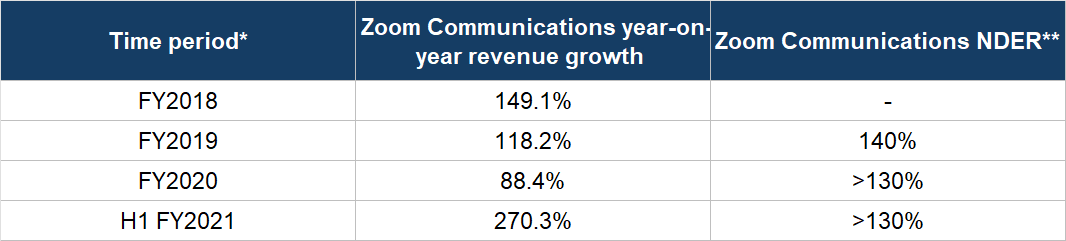
Table 1; Source: Zoom Communications IPO prospectus, FY2020 annual report, and quarterly earnings updates
*Note: FY2017 refers to the fiscal year ended 30 January 2017, FY2018 refers to the fiscal year ended 30 January 2018, and so on
**The NDER referred to in Table 1 is for customers with more than 10 employees
Zoom Communications’ products were also well-loved by users and in our thesis, we noted the company’s founder and CEO, Eric Yuan, had a “devotion to delivering happiness for Zoom’s customers” and that it was “a simple but unreplicable competitive advantage for the company.”
Given all the above and more, we thought Zoom Communications would be able to continue growing its revenue and free cash flow at high rates over the long run when we invested. It turns out our assessment was wrong, as Zoom has struggled in recent years to grow its business, as shown in Table 2 below:
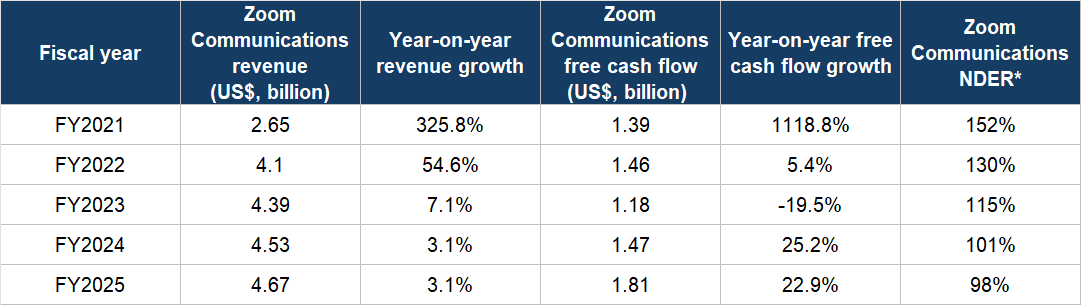
Table 2; Source: Zoom Communications annual reports
*Note: The NDER referred to in Table 2 is only for Enterprise customers, whereas the NDER referred to in Table 1 is for customers with more than 10 employees; the company communicated the change in the NDER definition during the FY2022 fourth-quarter earnings call
Management has created successful new products and features in recent times. Examples include:
- Zoom Contact Center, an omnichannel contact-center-as-a-service solution launched in February 2022, which had 1,250 customers in the third quarter of FY2025, up 82% year-on-year
- Zoom AI Companion, the company’s AI assistant feature, which was released in September 2023, saw its monthly active users increase by 68% sequentially in the fourth quarter of FY2025
- Zoom Workplace, an AI-powered collaboration platform announced in March 2024, scored a marquee customer-win in Amazon in the fourth quarter of FY2025
Management is also confident of monetising the plethora of AI-powered features that have been, or will be, infused into Zoom Communications’ products. Here’s management commenting on the matter in Zoom Communications’ FY2025 third-quarter earnings call:
“We are going to introduce the customized AI Companion, also AI Studio next year. Not only do we offer the free service for AI Companion, but those Enterprise customization certainly can help us in terms of monetization. At the same time, we leverage the technology we build for the workplace, apply that to the Contact Center, like Zoom Virtual Agent, right, and also some other Contact Center features. We can share the same AI infrastructure and also a lot of technology components and also can be shared with Zoom Contact Center.
Where AI Companion is not free, the Contact Center is different, right? We also can monetize. Essentially, we build the same common AI infrastructure architecture and Workplace — Customized AI Companion, we can monetize. Contact Center, also, we can monetize. I think more and more — and like today, you see you keep investing more and more, and soon, we can also monetize more as well. That’s why I think we do not worry about the cost in the long run at all, I mean, the AI investment because with the monetization coming in, certainly can help us more. So, so far, we feel very comfortable.”
But Zoom Communications’ revenue growth has been anemic in recent years, and is expected to remain so in the near future at least; in the most recent earnings conference call before our sale of Zoom Communications’ shares from Compounder Fund’s portfolio, management guided for revenue growth of merely 2.7% in FY2026. In our view, Zoom Communications’ high-growth days are over – and way sooner than we expected when we first invested in the company in July 2020 – and so it’s time to part ways.
We made our initial investment in Zoom Communications at an average price of US$258 per share, but sold at a much lower average price of US$75. The big decline in Zoom Communications’ stock price might lead someone reading this to ask: “Couldn’t you have sold Zoom Communications earlier?” It’s a valid question. Our response will be something we shared in Compounder Fund’s Owner’s Manual:
“And on the topic of selling stocks, we will typically sell a stock in Compounder Fund’s portfolio if we find that the investment thesis is completely broken, or we have made a big mistake in our analysis. But we will be very slow to sell. The slowness is by design – it strengthens our discipline in holding onto the winners in Compounder Fund. Holding onto the winners will be a very important contributor to Compounder Fund’s long run performance.”
Part of the capital from the sale of Compounder Fund’s Zoom Communications shares was redeployed to some existing companies in the portfolio (in this case, the companies were Alphabet, Amazon, and The Trade Desk).
And here’s an important disclaimer: None of the information or analysis presented is intended to form the basis for any offer or recommendation; they are merely our thoughts that we want to share. Of all other companies mentioned in this article, Compounder Fund owns shares in Alphabet, Amazon, and The Trade Desk. Holdings are subject to change at any time.
