

Compounder Fund: Wix Sell Thesis - 12 Oct 2026
Data as of 11 October 2026
We first invested in Wix.com (NASDAQ: WIX) for Compounder Fund’s portfolio in July 2020. Our investment thesis for the company can be found here. In early-June 2026, we completely exited Wix. This article describes our Sell thesis for the company.
When we invested in Wix, the website building platform had a multi-year history of growing its premium subscriptions and revenue per subscriber, and successfully launching multiple new products and services. In doing so, Wix managed to compound its revenue at a strong annual clip of 45.4% from 2013 to 2019. Its annual growth in operating cash flow and free cash flow for 2015-2019 were also impressive, at 63.6% and 73.5%, respectively. We also thought that Wix had a massive US$300 billion market opportunity to grow into, and the company was “set to capitalise on strong secular tailwinds with a platform that is well-placed to meet the growing demand for businesses to shift online.”
After our initial investment in Wix, the company put up impressive revenue growth for two years. The growth rate then rapidly decelerated, albeit to a still-acceptable level. Wix also consistently generated operating cash flow and free cash flow, with both measures clearly moving upwards in the 2020-2025 time frame. Premium subscriptions were rising steadily before declining in 2024 and 2025. But the growth in average revenue per subscriber in those two years more than offset the dip in subscribers, allowing Wix to post double-digit revenue growth. All these are shown in Table 1 below.
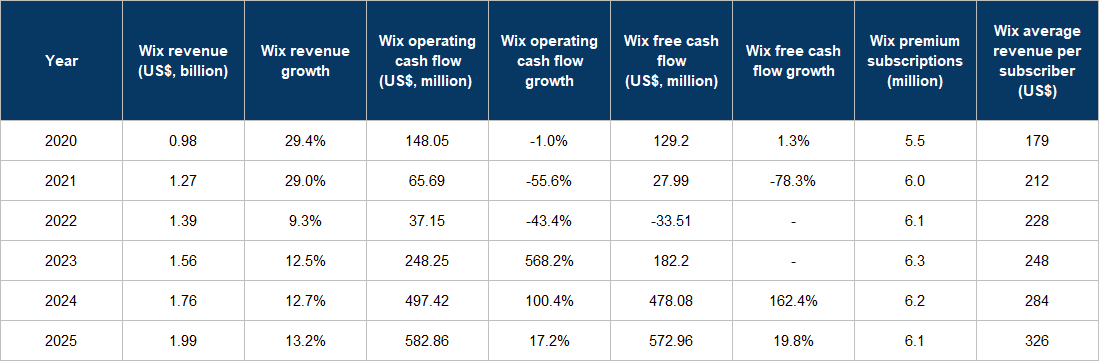
Table 1; Source: Wix quarterly earnings updates and annual reports
We started having concerns with Wix’s subscriber growth when the aforementioned dips appeared. Management shared in the 2024 fourth-quarter earnings call that they had turned their focus towards capturing and serving high-end subscribers for some time, which meant that the total number of premium subscriptions (which also included low-end subscribers) would be affected. We accepted this explanation.
But the trajectory of Wix’s business in 2026 gave us serious pause. In the company’s earnings update for 2025’s fourth quarter, management guided for mid-teens percentage growth in both bookings and revenue for 2026. This guidance was maintained in Wix’s 2026 first-quarter earnings update that was released in mid-May. But just three weeks later in early-June, management lowered guidance for bookings growth to the low-teens range, and for revenue growth to the “low-to-mid-teens” range. The guidance was weaker despite Base44, Wix’s AI coding subsidiary that it acquired in June 2025, continuing to grow rapidly. For perspective, Base44’s annualised recurring revenue was US$150 million this May, up from US$100 million in March, and just a few million when Wix acquired it. The official reason Wix’s management gave for the lowered guidance was a slowdown in the company’s core business from its reorganisation (Wix reduced its workforce by 20% in early-June this year) and its Partners business (the military skirmish between Israel/USA and Iran that started in February this year had delayed Wix’s product roadmaps for the Partners business, given that more than 60% of the company’s employees are in Israel). But we suspect agentic coding platforms such as Anthropic’s Claude Code, Cursor, and OpenAI’s Codex, are impacting demand for Wix’s platform. The timeline of model releases by Anthropic and OpenAI is instructive; Anthropic introduced Opus 4.7 in April while OpenAI released GPT 5.4 and GPT 5.5 in March and April, respectively. These model releases improved the capabilities of both companies’ agentic coding platforms, and thus possibly lowered the need for Wix’s website-building functions.
We also saw yellow flags in the capital allocation capabilities of Wix’s management team. Towards the end of January this year, management launched a US$2 billion share repurchase program that was supposed to run till the end of 2027. Then on 4 March, management announced that Durable Capital Partners and other investors would invest US$250 million in Wix at US$80 per share in a private placement. A day later, Wix announced that it had started a tender offer to repurchase up to US$1.75 billion worth of its shares at a price between US$80 and US$92 each; when the offer ended, Wix ended up paying US$92 per share and spent US$1.617 billion. The problem with the sequence of events with the private placement and tender offer is that Wix’s management had effectively sold cheaper shares of itself to repurchase more expensive shares. That is poor capital allocation. By itself, we thought it was a yellow flag. But when this was placed together with the issues we saw in Wix’s business that we described earlier, we thought it made sense to part ways with Wix, especially since we saw the opportunity to redeploy the capital in Meta Platforms at a highly attractive price.
And here’s an important disclaimer: None of the information or analysis presented is intended to form the basis for any offer or recommendation; they are merely our thoughts that we want to share. Of all other companies mentioned in this article, Compounder Fund owns shares in Meta Platforms. Holdings are subject to change at any time.
