

Compounder Fund: Mercer Bancorp Investment Thesis - 13 Jul 2026
Data as of 12 July 2026
Mercer Bancorp (OTC: MSBB) is a company in Compounder Fund’s portfolio that we invested in for the first time in early-June 2026. This article describes our investment thesis for the company.
Company description and background
We invested in Mercer Bancorp because we believe it’s currently undergoing a special situation. Consequently, this investment thesis will not have the same structure as our other theses.
Mercer Bancorp is the holding company for Mercer Savings Bank, which was established 138 years ago in 1888 in the state of Ohio, USA. Today, the bank remains headquartered in Ohio, and it has five branches, four of which are in the same state; the remaining branch is in the neighbouring state of Indiana.
Mercer Savings Bank primarily lends to individuals for residential and commercial mortgages, agricultural loans, commercial loans, HELOCs (home equity lines of credit), installment loans, and automobile loans. As Table 1 below shows, residential real estate loans are the largest category of loans for the bank and accounted for 61% of its total loans portfolio as of 31 March 2026. Agricultural loans are the second most important category of loans for Mercer Savings Bank and that’s a risk, as we’ll discuss in the “The risks involved” section of this thesis.
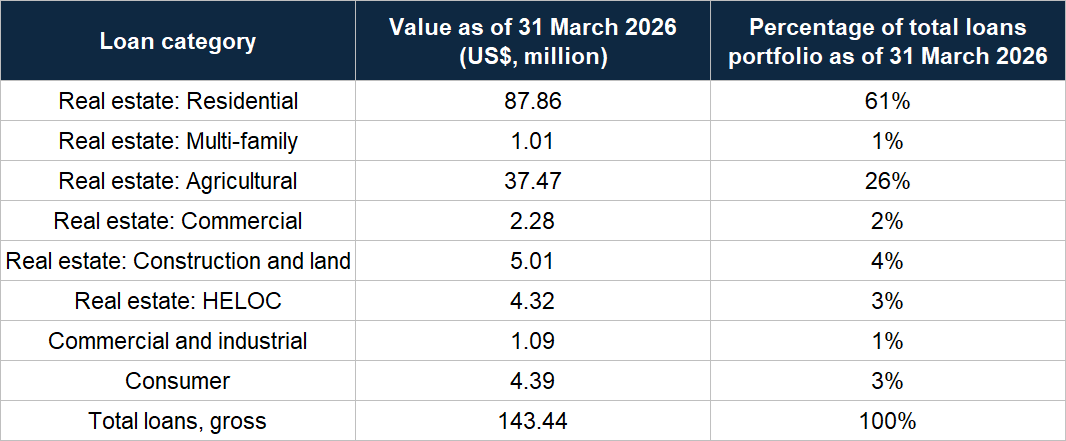
Table 1; Source: Mercer Bancorp FY2026 second-quarter filing
Most of Mercer Savings Bank’s borrowers reside in Mercer and Darke counties in Ohio, and Adams and Jay counties in Indiana. The bank’s residential and agricultural loans typically have a maximum loan-to-value ratio of 80%, so the bank does not appear to have aggressive lending practices.
The special situation
We see Mercer Bancorp as a special situation investment opportunity because it is a thrift conversion. We discussed thrift conversions in detail, including the conversion mechanics and the returns-potential, in our 2024 fourth-quarter and 2025 second-quarter letters. In these letters, we laid out the investment criteria we look out for in thrift conversions:
- “The equity-to-assets ratio: The higher the better, as it signifies an over-capitalised and strong balance sheet, and would make a thrift look attractive to a would-be acquirer
- The P/TB [price-to-tangible book] ratio: The lower the better, as a P/TB ratio that is materially below 1 will (a) make share buybacks a value-enhancing activity for a thrift’s shareholders, and (b) enhance the potential return for us as investors
- Share buybacks: The more buybacks that happen at a P/TB ratio below 1, the better, as it is not only value-enhancing, but also indicates that management has a good understanding of capital allocation
- Non-performing assets as a percentage of total assets: The lower the better, as it signifies a thrift that is conducting its banking business conservatively
- Net income: If the play is for a potential acquisition of a thrift, we want to avoid a chronically loss-making thrift as consistent losses indicate risky lending practices, but the amount of net income earned by the thrift is not important because an acquirer would be improving the thrift’s operations; if the play is for a thrift to generate strong returns for investors from its underlying business growth, then we would want to see 20 a history of growth in net income and at least a decent return on equity (say, 8% or higher)
- Change in control provisions: This relates to payouts that a thrift’s management can receive upon being acquired and such information can typically be found in a thrift’s DEF 14-A filing; if management can receive a nice payout when a thrift is acquired, management is incentivised to sanction a sale
- Management’s compensation: The annual compensation of a thrift’s management should not be high relative to the monetary value of management’s ownership stakes in the thrift”
Mercer Bancorp completed its standard conversion, where its ownership structure changed from being mutually owned by depositors to having public shareholders, on 26 July 2023.
Here’s how the company stacks up against our criterion for thrift conversions.
On the equity-to-assets ratio
As of 31 March 2026, Mercer Bancorp had total assets of US$173.936 million and tangible common stockholders’ equity of US$25.1 million. This gives a healthy tangible common stockholders’ equity to assets ratio of 14.4% on the surface. But the following adjustments need to be made:
- Mercer Bancorp’s total assets include loans held for sale with a carrying value and fair value of US$6.146 million and US$6.618 million, respectively, as of 31 March 2026. The company’s total assets also include net loans of US$141.845 million whose fair values are US$135.597 million.
- Mercer Bancorp’s tangible common stockholders’ equity becomes US$19.324 million after adjusting for the fair values of the loans held for sale and net loans. This leads to the adjusted tangible common stockholders’ equity to assets ratio declining to a still decent 11.5%.
On the P/TB ratio
Using Mercer Bancorp’s reported financials, it has a tangible book value per share of US$24.77 as of 31 March 2026. This gives a P/TB ratio of 0.77 at our average purchase price of US$19.02 per share. But if Mercer Bancorp’s adjusted tangible common stockholders’ equity was used, the adjusted P/TB ratio rises to 1.0 with an adjusted tangible book value per share of US$19.07. On the surface, an adjusted P/TB ratio of 1 does not look interesting. But we’ll explain why the company still looks attractive to us in the “The return potential” section of this thesis.
On share buybacks
Converted thrifts can repurchase shares after the first anniversary of their conversion and Mercer Bancorp has done that. In December 2024, management launched the company’s first, and so far only, repurchase programme, which was for 102,297 shares, or 10% of the then-outstanding share count. As of 31 March 2026, management has repurchased 42,807 shares, or just over 4% of the outstanding shares when the programme was announced. For perspective, Mercer Bancorp had 1.013 million shares outstanding as of 11 May 2026.
Ideally, we want to see more repurchases, since Mercer Bancorp’s stock price was at a discount to both its reported and adjusted tangible common stockholders’ equity for most of the time period between the first anniversary of the thrift’s conversion and today. But Mercer Bancorp’s trading liquidity is low (the number of shares traded daily is often zero, for example), so there are practical constraints on the extent of repurchases that can be done. All told, we see Mercer Bancorp’s aforementioned repurchase programme as a positive signal on management’s understanding of capital allocation.
On non-performing assets
Mercer Bancorp’s non-performing assets as a percentage of total assets since FY2021* (financial year ended September 2021) are shown in Table 2 below. The numbers are low, which is a sign of healthy lending operations at the company.
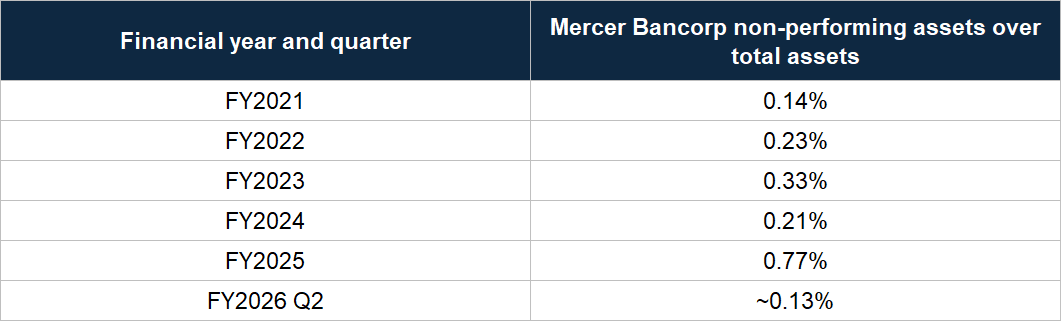
Table 2; Source: Mercer Bancorp annual reports and quarterly filings
*The earliest financial data we could find for Mercer Bancorp goes back to FY2021.
On net income
Mercer Bancorp’s net income has been positive going back to FY2021 as shown in Table 3 below.
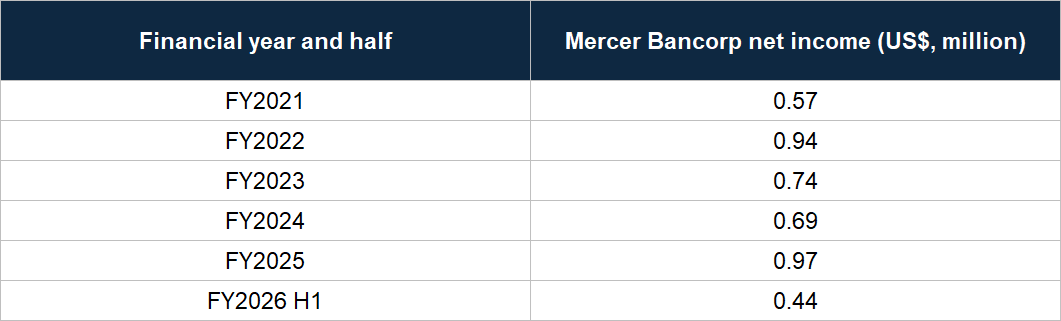
Table 3; Source: Mercer Bancorp annual reports and quarterly filings
On change in control provisions
The most important leader in Mercer Bancorp is the 55 year-old Barry Parmiter, who joined the company in February 2022 as CEO and remains in the same role today. Prior to taking the helm at Mercer Bancorp, he was the CEO of another thrift, Community Savings Bancorp, from 1998 to February 2022. His previous stint with Community Savings Bancorp is an important pillar of our investment thesis for Mercer Bancorp which we’ll discuss in the “The return potential” section of this thesis.
Parmiter’s compensation plan includes attractive change in control provisions. If Mercer Bancorp or Mercer Savings Bank is acquired and Parmiter’s employment ends, he will receive the following: (1) Three times his average annual income for the five years prior to a change in control, and (2) life insurance and healthcare coverage for two years.
On management compensation
The compensation of Parmiter is high relative to the scale of Mercer Bancorp. For perspective, his total compensation in FY2025 was US$521,465, which was 54% of the company’s net income for the year.
As of 26 December 2025, Parmiter controlled 29,534 Mercer Bancorp shares, which have a value of just over US$561,000 at our average purchase price of US$19.02. This is similar in value to Parmiter’s aforementioned compensation for FY2025. But Parmiter’s compensation during the year was inflated by one-time equity awards consisting of US$143,220 in restricted stock and US$126,591 in stock options granted under Mercer Bancorp’s 2025 Equity Incentive Plan. Without the equity awards, his compensation would be US$230,625, which is meaningfully lower than the value of his shareholdings.
Pulling it all together
Given all the information mentioned so far, we see Mercer Bancorp as a thrift conversion with (1) a decent equity-to-assets ratio, (2) an adjusted P/TB ratio of 1.0 that still looks attractive underneath the hood, (3) healthy lending operations and a decent record of profitability, and (4) a management team with incentives that we think are aligned towards a sale of the company.
The return potential
We think it’s likely that a sale of Mercer Bancorp will happen in the near future for two reasons. Firstly, thrifts can sell themselves after the third anniversary of their conversion and Mercer Bancorp will reach this milestone on 27 July 2026. Secondly, Parmiter is a CEO who has previously run the thrift conversion playbook of taking a thrift public and then selling it. As we mentioned earlier, Parmiter was the CEO of Community Savings Bancorp, which was the holding company of Community Savings, a savings and loan association, from 1998 to February 2022. In June 2021, Community Savings Bancorp announced that it would be acquired by Double Bottomline. The deal, which was completed in December 2021, happened just four-and-a-half years after Community Savings completed its standard conversion in January 2017. With a successful sale of a converted thrift already under Parmiter’s belt, it’s possible that Mercer Bancorp could be sold soon after it crosses the third anniversary of its conversion.
We also think Mercer Bancorp is likely to be acquired at a material premium to its adjusted tangible book value per share because of historical precedents.
The first precedent involves Community Savings Bancorp, which was headquartered in Ohio, just like Mercer Bancorp. Based on the latest data for Community Savings Bancorp we could find, which was for the financial year ended 30 June 2019 (FY2019), it had a loan portfolio similar in shape to that of Mercer Bancorp today, as shown in Table 4 below. But when the acquisition of Community Savings Bancorp was announced, it had meaningfully weaker fundamentals compared to Mercer Bancorp’s current state. A few salient points on the fundamentals:
- Community Savings operated only one full-service branch in Ohio, compared to five branches for Mercer Savings Bank, four of which are in Ohio.
- The latest non-performing assets data we could find for Community Savings Bancorp is for its FY2019 and during the year, its non-performing assets was 1.29% of total assets. As shown in Table 2, Mercer Bancorp’s non-performing assets to total assets ratio in recent years was significantly better.
- From Community Savings Bancorp’s FY2015 to FY2019, it made a loss in all years except for FY2016. In contrast, Mercer Bancorp has a much better track record of profitability as shown in Table 3.
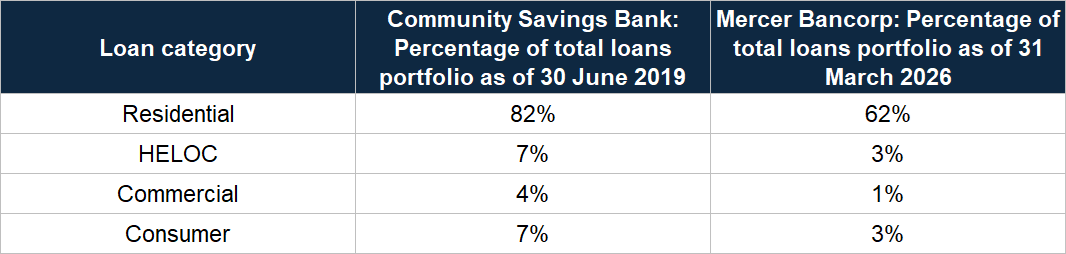
Table 4; Source: Community Savings Bancorp annual report and Mercer Bancorp FY2026 second-quarter filing
According to Community Savings Bancorp’s announcement for its acquisition, Double Bottomline paid US$9.5 million, or US$22.76 per share, which equated to a P/B (price-to-book) ratio of 1.22. If Community Savings Bancorp had intangible assets when the transaction was announced, this would result in a P/TB ratio higher than 1.22, as would also be the case if the reported value of the thrift’s equity was materially higher than the fair value. We do not have adequate data for confirmation, but we can be conservative and assume that there were no intangible assets and no material gap in value. In this scenario, Community Savings Bancorp’s reported equity back then would correspond to Mercer Bancorp’s adjusted tangible common stockholders’ equity today.
The second precedent is related to another converted thrift, namely Peoples-Sidney Financial Corp. This thrift was acquired by Farmers & Merchants Bancorp in October 2022, with the transaction first revealed in June of the same year. When the acquisition was announced, Peoples-Sidney Financial Corp looked similar in scale and quality to Mercer Bancorp today:
- Peoples-Sidney Financial Corp was headquartered in Ohio, as is Mercer Bancorp.
- Peoples-Sidney Financial Corp was the holding company for Peoples Bank, a savings and loan association with three banking offices in Ohio; as already mentioned, Mercer Bancorp has four offices in Ohio today, and one in Indiana.
- Peoples-Sidney Financial Corp had total assets of US$132.7 million and US$15.4 million in tangible common stockholders’ equity, giving an equity-to-assets ratio of 11.6%; Mercer Bancorp’s self-same numbers (of the adjusted variety) were US$168.15 million, US$19.314 million, and 11.5%, respectively.
- Peoples-Sidney Financial Corp’s non-performing assets to total assets ratio was estimated at 0.2%, comparable to Mercer Bancorp’s that’s shown in Table 2.
Peoples-Sidney Financial Corp was acquired by Farmers & Merchants Bancorp at a P/TB ratio of 1.75. Similar to the situation with Community Savings Bancorp, we are unable to obtain sufficient data on Peoples-Sidney Financial Corp to know if there was a big gap between the reported and fair values of its equity. For the sake of conservatism, we can also assume that no such gap existed. As such, Peoples-Sidney Financial Corp’s tangible common stockholders’ equity would correspond to Mercer Bancorp’s current adjusted tangible common stockholders’ equity.
We’ve already established that Mercer Bancorp currently has (1) stronger fundamentals compared to Community Savings Bancorp at the time of its acquisition, and (2) similar fundamentals compared to Peoples-Sidney Financial Corp when it was acquired. So, we think it’s likely that if and when Mercer Bancorp gets acquired, it could command an adjusted P/TB ratio that is meaningfully higher than Community Savings Bancorp’s 1.22 and is in the same ballpark as Peoples-Sidney Financial Corp’s 1.75. As a sanity check, if we assume that Mercer Bancorp would be acquired at an adjusted P/TB ratio of 1.5 to 1.7 using its latest financial data, this would correspond to a P/TB ratio of only 1.15 to 1.31 – both are lower than the average P/TB ratios that converted thrifts have historically been acquired for*.
If we assume that Mercer Bancorp’s adjusted tangible book value per share is US$19.07** if and when it’s sold, and it is acquired for an adjusted P/TB ratio of 1.5 to 1.7, the acquisition price will be between US$28.61 and US$32.42, which represents an upside of 50% to 70% from our average purchase price. And depending on when Mercer Bancorp announces its acquisition, the annualised rate of return could even be in the triple-digit range.
*In the section of our 2024 fourth-quarter letter discussing thrift conversions, we shared that according to a 2016 study on thrift conversions from investment bank Piper Jaffray, 70% of thrift conversions since 1982 sold themselves and these thrifts were acquired at an average P/TB ratio of 1.4.
**The assumption of a tangible book value per share of US$19.07 for Mercer Bancorp at the time of its sale is conservative. The figure is identical to what we calculated earlier for Mercer Bancorp’s adjusted tangible book value per share based on its financials as of 31 March 2026. Mercer Bancorp is currently profitable and does not pay a dividend. So as it generates profits each quarter, its adjusted tangible common stockholders’ equity, and thus adjusted tangible book value per share, will increase. It’s reasonable to assume Mercer Bancorp’s adjusted tangible book value per share will grow at a mid-single digit annualised rate, since the company’s estimated return on equity for FY2025 is 6%.
The risks involved
Here are the salient risks we see with an investment in Mercer Bancorp:
- There are no guarantees that an acquisition of Mercer Bancorp would happen soon or happen at all. If we find ourselves waiting for too long for the acquisition, the annualised rate of return would become poor. Based on Mercer Bancorp’s current state, we do not want to be long-term holders of its shares. As we demonstrated earlier with the company’s financials for FY2025, its historical return on equity is mediocre
- Even if an acquisition of Mercer Bancorp were to occur, the adjusted P/TB ratio involved may be much lower than the 1.5 to 1.7 range we had established as the likely outcome. In such a scenario, our upside would be diminished.
- Farm bankruptcies are on the rise in the USA. According to the American Farm Bureau Federation, 315 US farms went bankrupt in 2025, up 46% from 2024, which itself saw a 55% jump in bankruptcies from 2023. In the midwest of the USA, which includes Indiana and Ohio, the states where Mercer Savings Bank operates in, farm bankruptcies surged 70% in 2025. The financial situation for American farms could be worse in 2026. The USA and Israel attacked Iran in February this year, which led to Iran shutting the Strait of Hormuz soon after. A third of global seaborne fertilisers passes through the Strait of Hormuz, so its closure has disrupted global supplies and led to soaring prices for fertilisers. We showed in Table 1 that agricultural real estate loans accounted for 26% of Mercer Bancorp’s loan portfolio as of 31 March 2026. If more farmers in Ohio and Indiana end up struggling financially in 2026 and beyond because of the fertiliser-disruption, Mercer Bancorp’s business could be heavily impacted. For now, things appear to be fine as the company’s non-performing loans as of 31 March 2026 was in fact lower than at the end of FY2025.
Summary and allocation commentary
We invested in Mercer Bancorp because we think as a converted thrift, it could be acquired soon at a material premium to the average price we paid.
There are risks to note with Mercer Bancorp, namely, the possibility of its acquisition taking a long time to happen or not happening at all, a low valuation being offered by an acquirer, and the risk of US farm bankruptcies affecting its business.
On the back of all this information, we decided to allocate around 2.5% of Compounder Fund’s portfolio into Mercer Bancorp at our initial investment. We made Mercer Bancorp a medium-sized position to account for the risks we see.
And here’s an important disclaimer: None of the information or analysis presented is intended to form the basis for any offer or recommendation; they are merely our thoughts that we want to share. Of all other companies mentioned in this article, Compounder Fund has no other interests other than Mercer Bancorp. Holdings are subject to change at any time.
